Aloft Forums
You are using an out of date browser. It may not display this or other websites correctly.
You should upgrade or use an alternative browser.
You should upgrade or use an alternative browser.
Receiver/bettery/ESC packing question - Indian V glider
- Thread starter ahdofu
- Start date

Konrad
Very Strong User
That will be fun, NOT.Well in a way it does
P.S one of motor mount screws is inside the motor cavity. I am yet to fish it out with tweezers.


ahdofu
New User
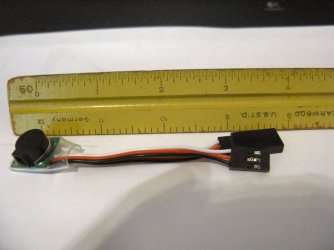
I have since acquired a smaller 6 channel receiver so now I have more room. Have a question. In my glow airplanes I have always used a "lost model beeper/locator. That one was made by Hobbico which is no longer available but it is too big for my glider. I see one that is available from Aloft but that unit runs off an unused channel which is not quite the same as Hobbico's. With Hobbico's unit, one would use an existing channel and once no stick movement is detected, the unit would act up and start beeping. It is embaressing to admit to this, but I have relied on the unit twice in the past so it is a worthwhile insurance. I searched thru the web and can only see similar items in Ebay (see this Link). Does anyone use something like this on his/her glider? And if so where did you acquire it from?
Konrad
Very Strong User
Don't use them.
99% of my lost models have been as a result of dead batteries. So the beepers would be of no value in that situation.
Many RF reporting features in to day's radio will serve the same function. Does your radio give you a signal strength indication? If so that can be used as a directional indication as to where the lost model might be.
With the range a glider can fly an audio signal is often of little help.
ahdofu
New User
Our field is surrounded by tall trees/bushes/grass, ,,, etc. The first time I lost my plane (pilot error), I knew of its approximate whereabouts but I would have never been able to find it once I got there as the plane had embedded itself inside one of the tall berry bushes. The second time was a bad battery issue. However the battery still had enough juice to run the beeper and again I managed to find the plane. Without the beeper I probably would have been able to find the plane given enough time. In this case once I arrived at the approximate area, the beeper noise helped me find it by a tree stump which was roughly 75 ft away. I'll order the one from ebay and will give it a try.
Given the relative size of my flying field, I won't be able to fly the glider too far but I suppose the glider may not crash and may fly away if signal is lost ...
Given the relative size of my flying field, I won't be able to fly the glider too far but I suppose the glider may not crash and may fly away if signal is lost ...
Konrad
Very Strong User
With the smaller Rx have you been able to remove the tail weight?
Yes, gliders often fly better with no commands from the pilot! I recently saw a very aerobatic slope glider fly out of sight. Only to be found 2 days later 270° from where it was last seen. It was lost as the battery became unplugged at the bottom of a loop. No RF monitoring or beeper would have helped locate this ship. It was found while looking for another ship's canopy. The battery still had a full charge. This is how we knew that the battery had become un plugged. If it was plugged in the battery would have been dead after spending 2 days out in the wilderness.
Your Indian V is in all likelihood even more stable than that slope aerobat. Lost gliders have been known to be located miles away from where they were last seen.
I'd save the space, weigh, and cost and not bother with the buzzer.
Yes, gliders often fly better with no commands from the pilot!
I recently saw a very aerobatic slope glider fly out of sight. Only to be found 2 days later 270° from where it was last seen. It was lost as the battery became unplugged at the bottom of a loop. No RF monitoring or beeper would have helped locate this ship. It was found while looking for another ship's canopy. The battery still had a full charge. This is how we knew that the battery had become un plugged. If it was plugged in the battery would have been dead after spending 2 days out in the wilderness.Your Indian V is in all likelihood even more stable than that slope aerobat. Lost gliders have been known to be located miles away from where they were last seen.
I'd save the space, weigh, and cost and not bother with the buzzer.
ahdofu
New User
With the smaller RX I can slide the battery further back by ~ 1 inch. On paper this may be just enough to do away with ~ 0.2 oz tail weight that I needed before.
tail weight reduction = (5.3 oz battery x 1 in)/31 in tail boom = 0.17 oz
I have since ordered the part. It is relatively cheap ($2). I'll report back on its weight, size and functionality. In the meantime I need to work the programming on my JR XG11 radio. Perhaps this is a further proof that my mind is continuing to calcificate as I am finding the manual and the programming steps to be quite difficult to follow.
Interesting tidbit on gliders being found miles away. Some of the more expensive drones have autopilots and using GPS, bring "home" the drone. I suspect some of the larger glider already have them.
Konrad
Very Strong User
RTH is not likely to help with a dead or disconnected battery. These won't work with non powered gliders as there needs to be a power source to drive the ship back home.
Remember that in all likelihood you will end up being about 5mm further aft than what is shown in the manual for the maiden.
$2 with shipping?
And yes, that JR and Futaba master/slave menu driven programing architecture drove me nuts. That is why I embraced the Multiplex Proffi and OpenTX programing architecture.
ahdofu
New User
I'll do a final balance of the model with my CG tool once all the components are in. I may need to change CG after the first flight as build manuals tend to lean in the nose heavy direction.
$1.99 total to be exact. It was shipped today with a tracking no.
Curse it but I have to use what I have at the moment with this radio. Perhaps later on I'll switch to an OpenTX system.
$1.99 total to be exact. It was shipped today with a tracking no.
Curse it but I have to use what I have at the moment with this radio. Perhaps later on I'll switch to an OpenTX system.
ahdofu
New User
That guide is for the older JR radios and not for the newer radio. Previously I was going to use my JR X388S radio. I followed the programming in the guide and all was well except that my 72 Mhz receiver was too big. Since I already had a JR XG11 with a smaller receiver, I made the decision that it was time to make the switch. XG11 has modes for butterfly, brake .., etc. They're all there but not very user friendly.
ahdofu
New User
I just received the beeper. It must weigh less than 0.1 oz as my scale does not even register a weight. I have it attached to one of the aileron channels. With no stick movement and after ~ 2 min, it starts emitting long beeps and after ~ 2 min after that, it begins its short beep distress signal. This is exactly what I was looking for. Now it is time to package everything together.